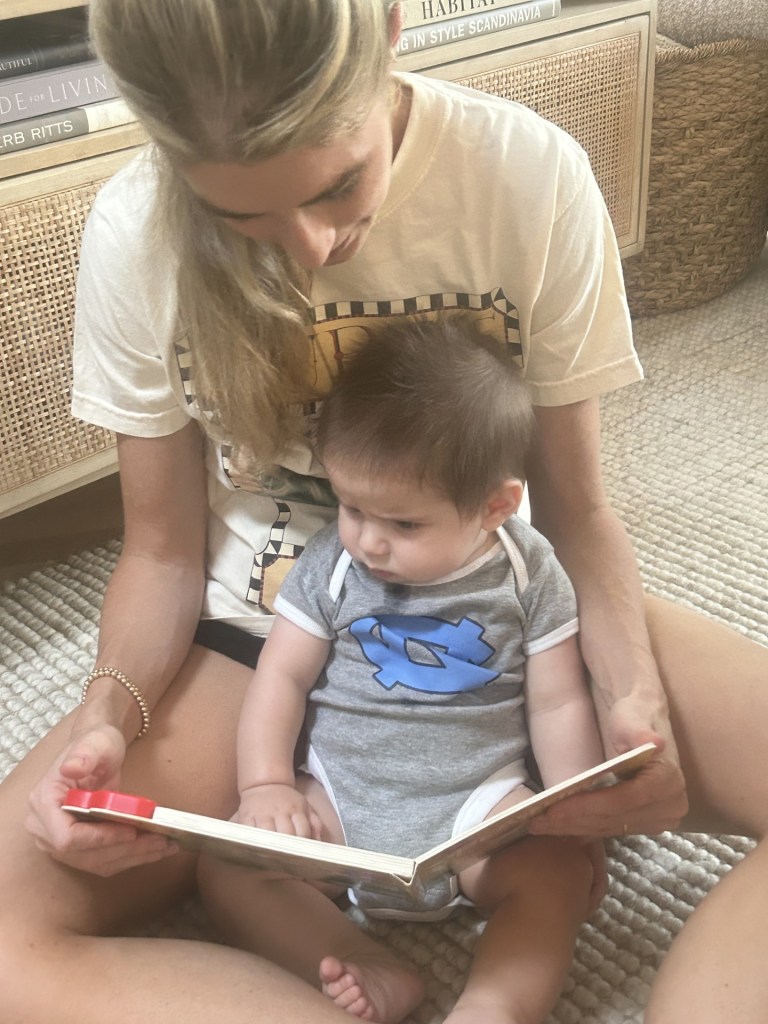
Remember learning about the five senses?- sight, sound, touch, taste and smell? We definitely take them for granted as adults, but if we have little ones in our lives, we are naturally focusing on these senses frequently.
As we plan reading time with our littles, it’s important to incorporate these senses. If this is how our children start to learn and process, we shouldn’t eliminate the use of these senses as we BOOK TIME WITH THEM. If they process using their senses, let’s use them as we teach them to process information through the written word.
“Multi-sensory instruction incorporates the use of visual, auditory, and kinesthetic-tactile modalities in the components of learning to read. This is achieved through the process of motor sequencing and sensory feedback. When we see, hear, and move to learn, the areas of the brain engaged are the Frontal Lobe (speech, grammar, language, and comprehension), the Temporal Lobe (decoding and sound discrimination), and the Angular Gyrus (links the brain together, reading conduction)”, Journal IMSE.com
SIGHT: we can use books that are visually stimulating to engage our children. Babies and toddlers are drawn to bright colors and also to black and white pictures. We can also use topics that are of unique interest to our children. For example, if there is a picture of a tractor, excavator, or truck on the cover, my grandson Leo is instantly interested! I know what he likes right now, and I purposefully select books that show that topic visually. It’s also helpful to select stories with illustrations that are attractive and stimulating, but not too busy. Choosing age-appropriate illustrations and the right amount of text (not too long) can be quite helpful.
SOUND: this sense is also one that we can build into our reading process. We can select books with rhythm and rhyme, which just creates fun for everyone. They will begin to recognize words that sound alike and we can omit words for them to SAY ALOUD. As I mentioned in my previous post Recognizing Rhymes!, “Our kids can be excited and belt out the missing (rhyming) words and TELL US how the story goes! They will think this is fun and it will build confidence too, but we know that reading skills are being developed in those formative little minds.”
My daughter has also invested in many books that have sound within the story; there is a button to push on each page. The boys have books that play music, make truck sounds, and make animal sounds. Yes, they have the Baby Shark books that the boys sing along to as well. My Dad bought them some books that expose them to songs by Mozart and famous musicians. Sometimes, their father will play the music that coincides with the story, as in Baby Beluga or What a Wonderful World. This creates a whole new level of fun interaction!
Leo will also say “Listen, listen!” when he hears an airplane or a loud truck go by. We can apply what we learned earlier in reading, and make connections when we hear the actual sounds LIVE.
TOUCH: this sense presents a unique way to interact with a story. I started tapping to the rhythm as I would read books to the grandsons and this instantly engaged them more fully. Not only does this keep their attention, but they are starting to understand rhythm as well. Now, both of the boys tap along on their own…..well, Zander may bang more than tap :). Using books with texture, books with FLAPS, and books that crinkle are all ways to incorporate the sense of touch within our reading.
TASTE: using taste may be a bit more challenging, but there are activities that can coordinate taste/food with our reading time. As I mentioned in a post titled Reading RECIPES, with Results!, “Cookbooks are books too. An easy, fun, and interactive way to “read” with our kids is to use cookbooks! There are so many benefits to using cookbooks with our kiddoes. We’re asking them to read, think, evaluate, and create all at the same time!” We can use family recipes or recipes that we clip from a local magazine. As the holidays approach, there are special occasions and traditions that may provide the perfect opportunity to read through recipes and cook/create together!
SMELL: using the sense of smell as we read may present the greatest challenge of all of the senses, but we can get creative, right? These connections may occur later, and we can be intentional about pointing them out. For example, if we’ve read a book like The Noisy Woods (or a book about camping), we can talk about it when we are in that specific location. Here’s an example, “Remember that page about the campfire crackling? Listen…and smell the scent of that wood burning”- “Smell that fresh mountain air”- or “Smell those flowers, that’s jasmine.” Books about the outdoors and books about nature or gardening will provide nice connections and applications for real life scents and smells.
It’s important to remember that our kids are seeing, smelling, tasting, feeling and hearing many things for the first time each day and week! Things that seem ordinary to us as adults are brand new experiences for our littles. As we BOOK TIME WITH OUR KIDS, let’s use ideal opportunities to teach and link the written word to the Wonderful World all around us.
THANKS FOR READING! Please subscribe for a weekly idea of how we can BOOK TIME WITH OUR KIDS. Please share t


 Nina Wheeling
Leave a reply to Anonymous Cancel reply